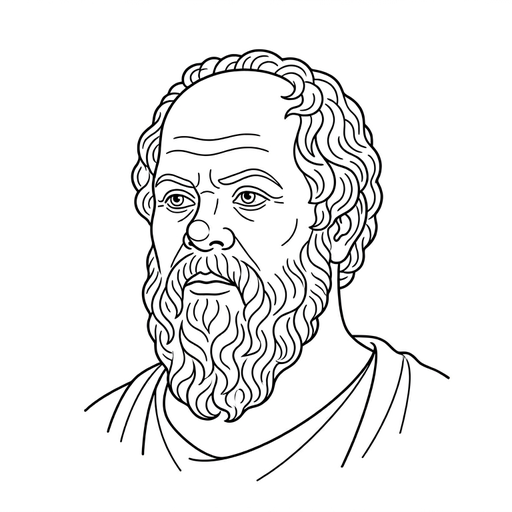
Socrates
Holds the question open and refuses premature certainty.
Not a better chatbot. Not a better prompt. Socrates is a memory-bearing dialectic engine that helps an Actor surface the assumption they did not know they had.
RLHF improves average model behavior across many users. General chatbots optimize for answer completion or engagement. Socrates is pointed at a different unit of value: the Actor's movement from hidden assumption to clearer next question.
“Your AI asks really good questions to challenge the questioner, help them get to the truth of their situation, and find their own solution.”
Socrates is a Socratic AI in the literal sense: the questions come from the machine and the intelligence comes from you. It asks one question at a time, builds each from your last answer, and leaves the conclusion to you. As an AI thinking partner or an AI sounding board, it holds a question open past the point where a helpful assistant would close it.
That makes it useful as AI for decision making and AI for self reflection, where an answer has to be yours to be worth anything. It is an AI that challenges your thinking without arguing with you. A Socratic chatbot built for teaching quizzes you toward an answer it already holds; Socrates has no answer waiting, and uses Socratic questioning on your own situation until you reach one.
No single component carries the whole differentiation. The system becomes different because the components are pointed at the same object: not the answer, but the evolution of inquiry.
Sprint keeps the disciplined five-step spine. Chat lets the Actor pause, backtrack, ask why, follow a tangent, and return only when the conversation has earned synthesis.
Actor memory, graph context, and uploaded documents enter the same inquiry field. The point is not generic retrieval; it is bringing external material into contact with internal patterns.
Socrates, Strategist, Mirror, and Challenger pressure the same question from different vectors. The session leaves behind an artifact, so the inquiry accumulates instead of evaporating.
Sprint is the structured artifact-producing mode. Chat is the elastic layer: open-ended enough to stay alive, disciplined enough not to collapse into generic conversation.
Personas are not characters for performance. They are cognitive lenses that pressure the Actor's question from different directions while staying grounded in the same memory and context.
Holds the question open and refuses premature certainty.
Tests sequence, constraints, tradeoffs, and next action.
Reflects what the Actor’s own language reveals.
Attacks the position so the Actor can see what holds.
Bring a real question. If the system works, you will not leave with more output. You will leave with a better question.